
What is CrowdStrike?
CrowdStrike is a cybersecurity firm known for its endpoint protection and threat intelligence products. Founded in 2011, the company provides cloud-native cybersecurity technology used by Fortune 500 companies, global banks, healthcare providers, and organizations across many other sectors to detect and respond to cyberattacks.
What Does CrowdStrike Offer?
CrowdStrike's core product, the Falcon platform, protects endpoints such as computers, servers, and IoT devices. The Falcon Sensor provides real-time detection and response by monitoring devices for suspicious activity, operating with deep system privileges through a driver, csagent.sys, that runs at the kernel level of the Windows operating system. Separately from sensor software updates, the sensor also regularly receives small configuration files called Channel Files, which tune its behavioral detection without requiring a full software release. These updates happen multiple times a day as routine operation.
What Happened?
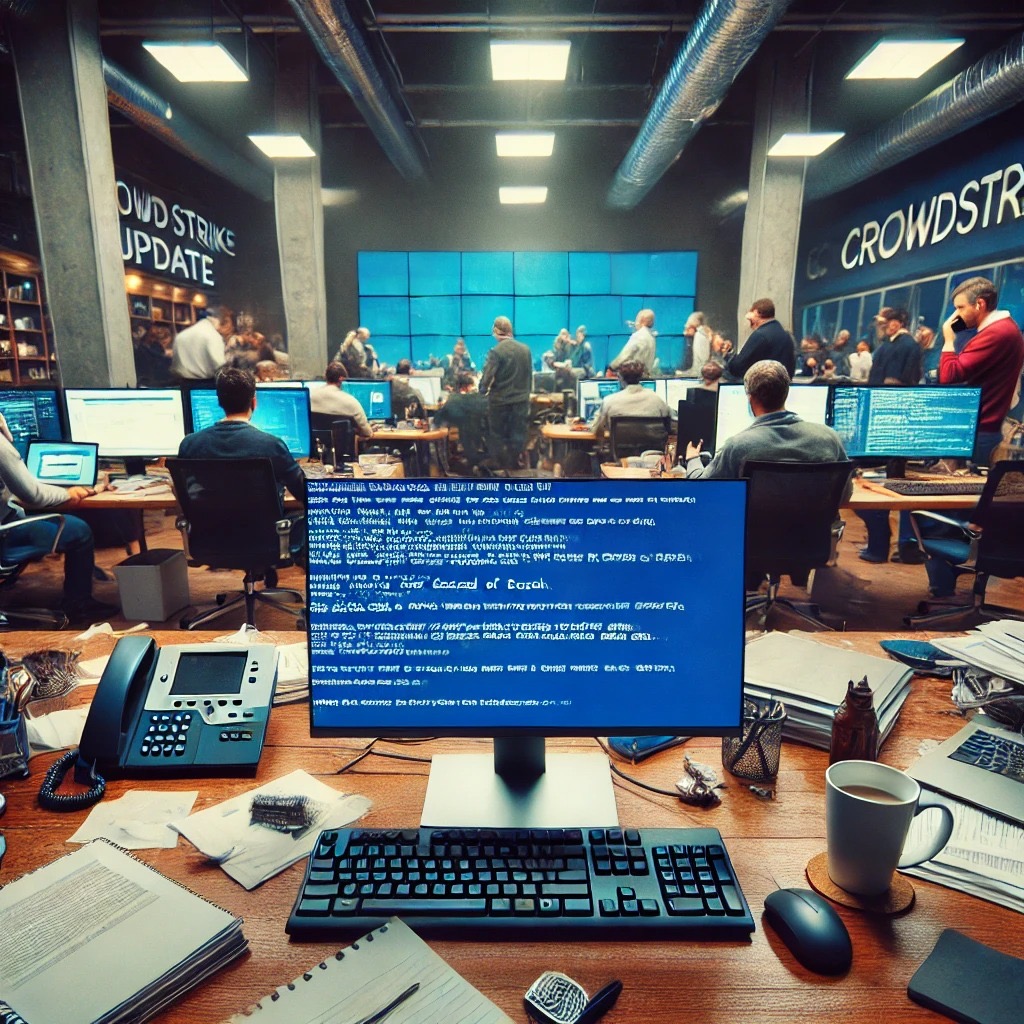
At 04:09 UTC on July 19, 2024, CrowdStrike released a Rapid Response Content update to Channel File 291, the file responsible for helping the Falcon sensor evaluate a particular type of Windows inter-process communication. The update contained a mismatch: the file's format expected 21 input fields, but the sensor code that processes it only supplied 20. That mismatch had gone undetected in earlier versions of the same template because those versions used a wildcard match on the 21st field. The new version used a specific, non-wildcard match on that same field for the first time, and the resulting mismatch triggered an out-of-bounds memory read inside the sensor's Content Interpreter, a fault Windows could not recover from, producing a Blue Screen of Death on affected machines. CrowdStrike identified the problem and reverted the file by 05:27 UTC, but any system that had already downloaded the bad version in that roughly hour-long window was affected.
The Side Effects
Microsoft estimated that 8.5 million Windows devices were affected, less than one percent of all Windows machines worldwide, but concentrated heavily among enterprises running critical services. Banks, airlines, hospitals, retail chains, and media outlets experienced severe disruptions. Delta Air Lines was among the hardest hit, canceling roughly 7,000 flights over five days and disrupting travel for an estimated 1.3 million customers. Cyber insurance analytics firm Parametrix estimated the outage cost Fortune 500 companies, excluding Microsoft, at least $5.4 billion in direct financial losses, with healthcare the hardest-hit sector at an estimated $1.94 billion. CrowdStrike's own stock fell roughly 11 to 14 percent on the day of the incident and was down close to 40 percent for the year.
Legal Fallout
In October 2024, Delta filed suit against CrowdStrike in Fulton County Superior Court in Georgia, seeking more than $500 million in damages, alleging the company circumvented its own testing and certification processes before pushing the update. CrowdStrike countersued the same day, arguing its liability is contractually capped at a much smaller figure and that Delta's own slow recovery, not the update itself, was responsible for the extended disruption to its operations. In May 2025, a Georgia judge dismissed Delta's fraud and intentional misrepresentation claims but allowed its negligence and computer trespass claims to proceed, meaning the case remains active.
Mitigation
CrowdStrike identified and reverted the problematic Channel File within roughly an hour of the initial deployment. For systems already affected, the company provided manual remediation steps: booting into Safe Mode or the Windows Recovery Environment, navigating to the CrowdStrike directory, and deleting the affected channel file. Virtual environments required additional steps involving detaching and repairing disk volumes. Because Channel File 291 only affects Windows systems, CrowdStrike confirmed that Linux and macOS devices were never impacted. Despite the file being reverted quickly, recovery still required manual intervention on millions of individual machines, extending the disruption for days at many organizations.
Conclusion
CrowdStrike's own root cause analysis points to a validation gap rather than a single bad line of code: a parameter mismatch that had been masked by wildcard matching in every prior version of the same template, until a routine update exposed it for the first time. That's a useful lesson independent of anything specific to CrowdStrike, since it shows how a testing gap can sit undetected for months across many successful deployments before a single ordinary change reveals it. The scale of the fallout, still working through litigation a year later, reflects how deeply embedded a single kernel-level security tool can become across an entire economy's critical infrastructure.
Sources
CrowdStrike, "Channel File 291 Incident Root Cause Analysis." crowdstrike.com/wp-content/uploads/2024/08/Channel-File-291-Incident-Root-Cause-Analysis-08.06.2024.pdf
CrowdStrike, "Technical Details: Falcon Update for Windows Hosts." crowdstrike.com/en-us/blog/falcon-update-for-windows-hosts-technical-details
Microsoft, "Helping our customers through the CrowdStrike outage." blogs.microsoft.com/blog/2024/07/20/helping-our-customers-through-the-crowdstrike-outage
Cybersecurity and Infrastructure Security Agency, "Widespread IT Outage Due to CrowdStrike Update." cisa.gov/news-events/alerts/2024/07/19/widespread-it-outage-due-crowdstrike-update
Parametrix, "CrowdStrike's Impact on the Fortune 500." parametrixinsurance.com/reports-white-papers/crowdstrikes-impact-on-the-fortune-500
Cybersecurity Dive, "Delta, CrowdStrike file dueling lawsuits as squabble continues." cybersecuritydive.com/news/delta-crowdstrike-lawsuit-georgia/731290
Transportation Today, "Georgia judge dismantles most of Delta's $500M lawsuit against CrowdStrike." transportationtodaynews.com/news/35539-georgia-judge-dismantles-most-of-deltas-500m-lawsuit-against-crowdstrike